Every septic tank fills with solids eventually — the question is only whether you pump it on your schedule or it announces itself on its own. A tank that's past due sends solids into the drain field, and once solids start migrating, a routine pump-out turns into drain field damage. In Palm Springs, where summer heat accelerates breakdown and hard water adds mineral crust to the mix, tanks deserve attention sooner than the national averages suggest.
Our pumping service is thorough, not rushed: we pump the full tank (not just the liquid layer), clean the effluent filter, check baffles and the inlet/outlet tees while the tank is open, and note the scum and sludge levels so you know where your system stands. The truck takes it all to a licensed disposal facility — no mess left on your property.
This is the right call if your drains are slowing, you're hearing gurgling, you smell sewage near the tank or in the yard, or it's simply been more than a few years. Desert homes with vacation-rental turnover should pump more often than a quiet household — we can tell you where you stand once we open the lid.
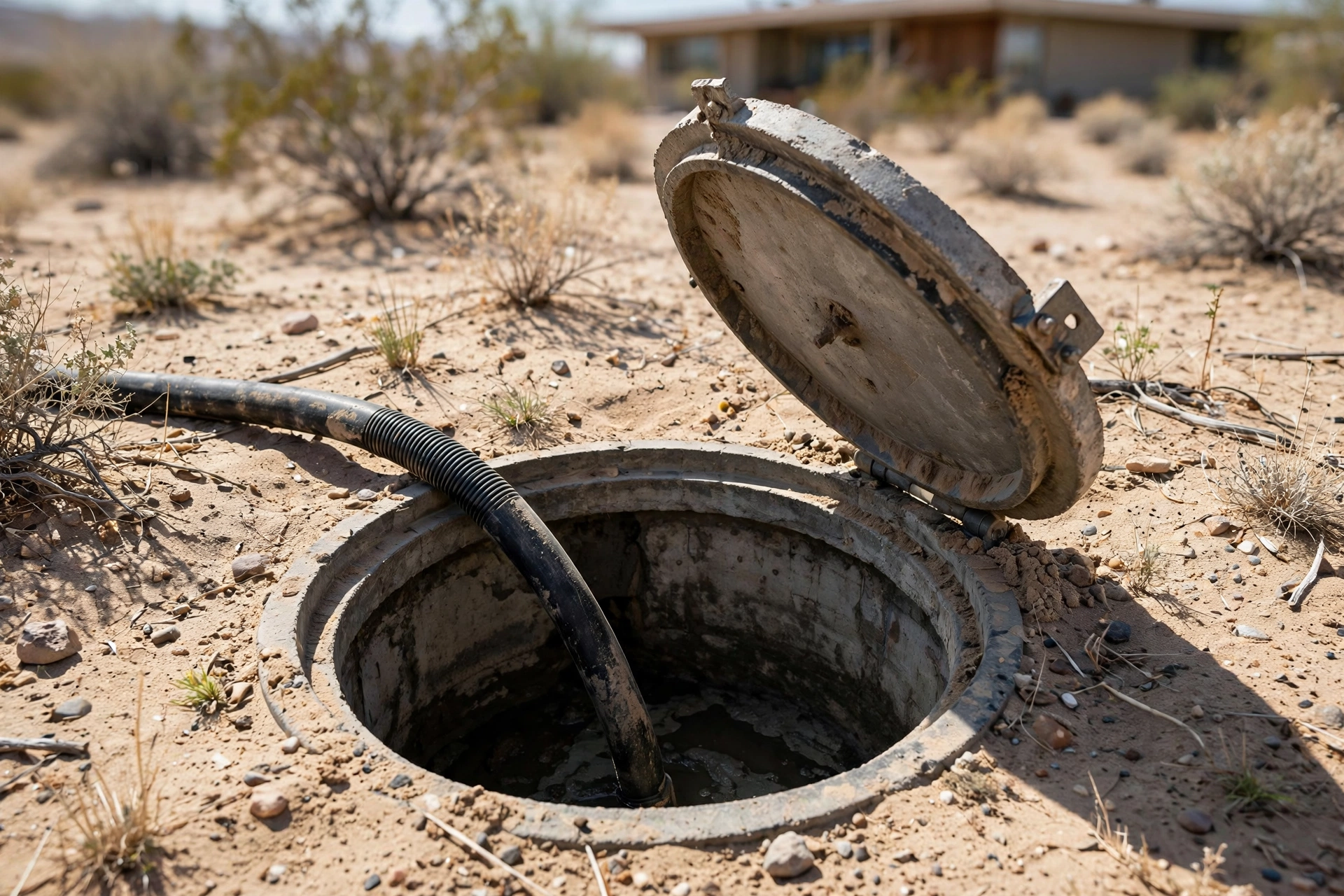
Signs your septic tank needs pumping
- Drains slowing throughout the house, especially lower fixtures
- Gurgling sounds from toilets or drains when water runs elsewhere
- Sewage odor in the yard near the tank or around the house
- Soggy, unusually green patches of grass over the drain field
- Toilets flushing weakly or backing up into tubs and showers
- It's been more than 3–5 years since the last pump-out
How our pump-out works
1 Locate and open the tank
We find the tank — with the risers if you have them, with our locator if the lid is buried — and open both chambers. Most desert homes we see have lids buried under a foot or more of soil, so don't worry if you have no idea where yours is.
2 Pump it completely
We pump the entire contents — liquid, sludge, and scum layers — back to bare walls. A partial pump leaves the worst of the solids behind, which defeats the purpose, so we don't do partials.
3 Inspect while it's open
With the tank empty, we check the baffles, inlet and outlet tees, and the effluent filter — the parts that fail silently. Palm Springs hard water crusts these components fast, and we clean or flag whatever we find.
4 Report and advise
You get a straight report: what the levels were, what condition the tank is in, and when it should be pumped again based on your household — not a generic calendar answer.
Pumping in Palm Springs conditions
Desert households use septic tanks differently than the national averages assume. Summer heat over 110°F speeds the biology inside the tank, which sounds helpful until it means scum and sludge layers shift faster and crust harder. Palm Springs' famously hard water lays mineral scale on effluent filters and baffles between pump-outs — a filter that would last years elsewhere can crust over in one. Then there's the rental factor: vacation rentals in Desert Hot Springs, Thousand Palms, and the outlying Palm Springs pockets push weekend-level water use through systems sized for one family, filling tanks far ahead of schedule. We see the result constantly: systems that 'should' have been fine for years, overwhelmed in eighteen months by guest turnover. If your property hosts guests, pump on a rental calendar, not a household one.
Need septic tank pumping in Palm Springs?
No forms, no waiting — one call connects you with a local technician.
(555) 123-4567 📞 Call Now